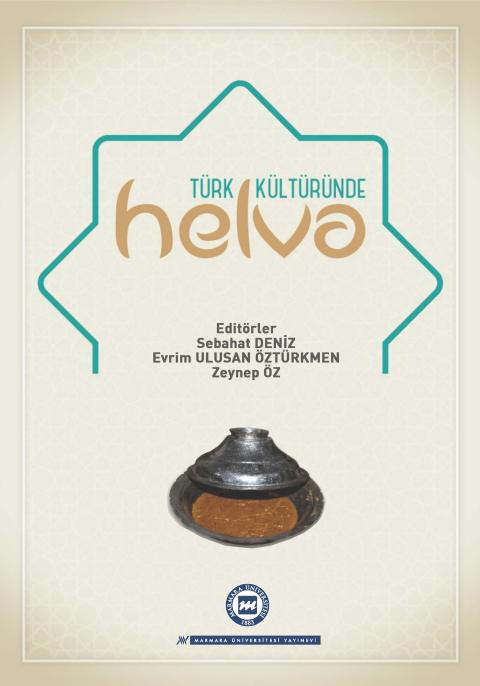
Türk Kültüründe Helva
Editor : Sebahat Deniz
Assistant Editor : Evrim Ulusan Öztürkmen, Zeynep Öz
About the Book
The essays in the book Halva in Turkish Culture are the outcome of a three-year research project supported by Marmara University Scientific Research Projects Coordination Unit, culminating in an academic symposium. The study aims to examine halva — which has transcended its role as a simple confection in Turkish culture — through a holistic and interdisciplinary lens. It brings together contributions from researchers in folklore, literature, history, anthropology, linguistics, gastronomy, and sociology. Halva is a material culture element that appears at every stage of life, from birth to death, from weddings to military send-offs, from holy nights to mourning ceremonies, surrounded by a rich complex of symbols and rituals. The research covers all seven geographical regions of Turkey, with fieldwork conducted in the provinces of İzmir, Aydın, Manisa, Muğla, Denizli, İstanbul, Kütahya, Çanakkale, Edirne, Tekirdağ, Sinop, Tokat, Çorum, Çankırı, Ordu, Kayseri, and Artvin. In addition, through interviews with families who had migrated to İstanbul, the living halva culture of cities such as Erzurum, Sivas, Bolu, and Bursa was also documented. The historical sources examined span a broad temporal range, from the 11th century to the end of the Ottoman period.
This edited volume comprehensively demonstrates that halva in Turkish culture is not merely a sweet; it is a distinctive cultural element that has left its mark across a wide spectrum — from literature to rituals, from everyday menus to festivities, from the fixed structures of language to sacred practices — and that, despite the availability of many alternatives, has maintained its attachment to the sacred domain and to tradition. The principal topics addressed in the book include: traditions such as the funeral halva (ölü helvası), charity halva (hayır helvası), votive halva (adak helvası), and halva gatherings (helva sohbetleri), along with the social integration and solidarity environments they generate; the varieties of halva from past to present; the organization of the halva-makers' guild in Ottoman Istanbul; the historical and cultural journey of the ingredients that constitute halva; Turkish halva culture through the eyes of travelers; a broad textual survey extending from the Divânü Lügati't-Türk to Classical Ottoman poetry; proverbs, idioms, similes, and poetic imagery related to halva; and the living halva traditions in contemporary Anatolia and Istanbul.
The key findings of the research may be summarized under four headings. The first is cultural continuity: Halva, once an element of olfactory rituals in pre-Islamic Turkish beliefs, was transformed with the adoption of Islam and became central to the tradition of offering food for the dead. This continuity can be traced without interruption from the 11th century to the present day. The second is multifunctionality: Halva is one of the rare cultural objects that simultaneously fulfills several distinct functions — social integration, identity construction, access to the sacred, economic function, and the satisfaction of individual psychological needs. The third is traces in language: Proverbs and idioms such as "Lafla helva pişmez" (words alone cannot cook halva), "sabırla koruk helva olur" (with patience, even unripe grapes become halva), and "helva helva demekle ağız tatlanmaz" (merely saying "halva, halva" does not sweeten the mouth) demonstrate how deeply halva has penetrated the fixed structures of the Turkish language. In Classical Turkish poetry, halva formed a distinctive imagistic world associated with concepts such as the beloved, patience, Sufi maturation, and social status. The fourth is the testimony of Western observers: The texts of Western travelers who visited Ottoman lands reveal that halva and other sweets served as an important medium for introducing Eastern material culture to the West.
Keywords: Halva, Culture, Literature, Ritual, Gastronomy, Oral culture.
Additional Information
| Category | Life Sciences |
|---|---|
| Book Type | Editorial |
| Print Language | Türkçe |
| Print Type | Electronic |
Table of Contents
|
Türk Kültüründe Ritüelistik ve Sosyalleşme Amaçlı Helva Yapım Gelenekleri
Author: Özkul Çobanoğlu
Page Range: 1-5
Page Range: 1-5
|
ePub Pdf |
|---|---|
|
Türklerde Ölü Aşı Verme Geleneğinin Bir Parçası Olarak Helva Dağıtma
Author: Mehmet Aça
Page Range: 6-10
Page Range: 6-10
|
ePub Pdf |
|
Helvanın Şekeri
Author: Çiğdem Kara
Page Range: 11-21
Page Range: 11-21
|
ePub Pdf |
|
Helva Sohbetleri ve Helva Çeşitleri
Author: Günay Kut
Page Range: 22-28
Page Range: 22-28
|
ePub Pdf |
|
18. Yüzyıl İstanbul’unda Helvacı Esnafı ve Helva Çeşitleri
Author: Arif Bilgin
Page Range: 29-58
Page Range: 29-58
|
ePub Pdf |
|
Batılı Seyyahların Gözünden Tatlı ve Helva Kültürümüz: 16.-19. Yüzyıllardan Örnekler
Author: H. Nazlı Pişkin
Page Range: 59-70
Page Range: 59-70
|
ePub Pdf |
|
Kutsal Bir Yiyecek Olarak Helvanın Ritüellerdeki İşlevleri: İstanbul’daki Câferîler ve Uşşâkîler
Author: Evrim Ulusan Öztürkmen, Zehra Hamarat
Page Range: 71-87
Page Range: 71-87
|
ePub Pdf |
|
Türk Dili Yadigarlarında Şeker, Tatlı, Helva
Author: Bihter Gürışık Köksal
Page Range: 88-99
Page Range: 88-99
|
ePub Pdf |
|
Gelenekselden Güncele Çankırı Kültüründe Helva
Author: Serap Aslan Cobutoğlu
Page Range: 100-127
Page Range: 100-127
|
ePub Pdf |
|
Şairin Sabırla Helva Yaptığı Koruk
Author: Sebahat Deniz
Page Range: 128-141
Page Range: 128-141
|
ePub Pdf |
|
Divan Şiirinde Helvaya Dair Bazı Ayrıntılar
Author: Ümran Ay Say
Page Range: 142-163
Page Range: 142-163
|
ePub Pdf |
|
Klasik Türk Şiirinde Helva ile İlgili Benzetmeler
Author: Zeynep Öz
Page Range: 164-175
Page Range: 164-175
|
ePub Pdf |

This work is licensed under a Creative Commons Attribution-NonCommercial 4.0 International License.


